PREPUBERTAL CASTRATION AND COMPLICATIONS IN THE GENITOURINARY TRACT OF DOGS AND CATS
LITERATURE REVIEW
DOI:
https://doi.org/10.64956/gm-unifacol.v2i2.124Keywords:
Ovariohysterectomy, Canine, Feline, Orchiectomy, Genitourinary Disorders, Urinary IncontinenceAbstract
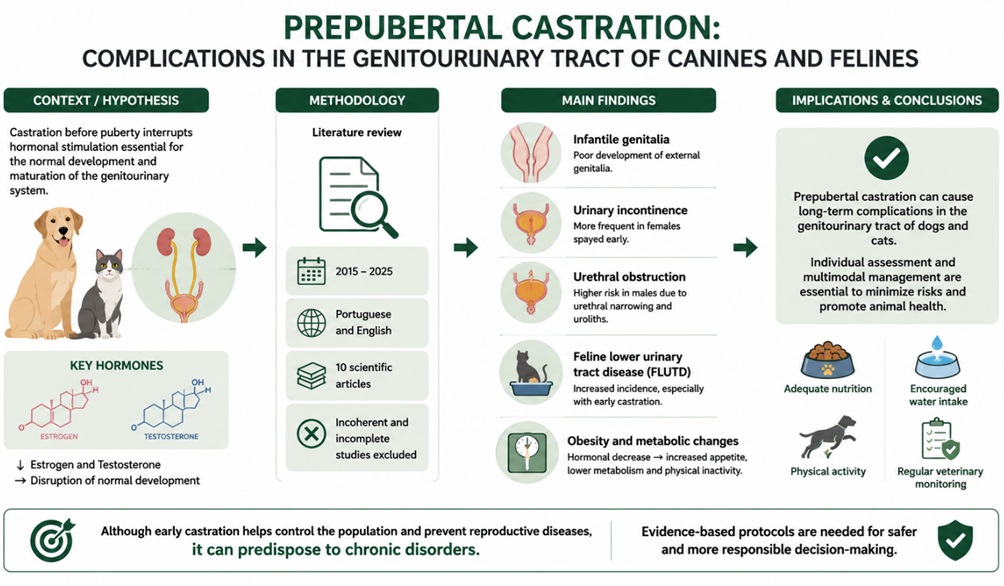
Ovariohysterectomy and orchiectomy are surgical procedures commonly performed in veterinary practice, mainly to control the dog and cat population and prevent or treat various diseases, such as pyometra, mammary tumors, and testicular neoplasms. However, the practice of early castration has become increasingly frequent. The main problem with this approach is the abrupt interruption of hormonal stimuli, especially estrogen and testosterone, before the animals' organs reach anatomical and functional maturity. In this context, this article aimed to analyze the available literature on the impacts of pre-pubertal castration on the urinary and reproductive systems of small animals. Inclusion criteria considered were articles published between 2015 and 2025, in Portuguese and English. Sex hormones play a crucial role in the maturation of tissues and structures, and their early suppression can result in long-term consequences. In males and females neutered prematurely, it is common to observe genitalia with infantile characteristics, in addition to the development of alterations such as urinary obstruction, urinary incontinence, and chronic vaginitis. Furthermore, neutering, regardless of age, promotes significant metabolic changes, creating a predisposition to obesity, a condition that can aggravate urinary tract infections. Therefore, multimodal management, involving adequate nutrition, encouragement of water intake, and physical activity, becomes essential in the post-neutering care of small animals. Therefore, although early neutering offers benefits—such as the prevention of reproductive diseases and effective assistance in population control—studies suggest it may also predispose animals to chronic diseases, making it necessary to analyze each patient individually and develop standardized protocols for a more accurate assessment of the effects resulting from pre-pubertal neutering.
References
ALVES, Brunna Fernanda Arraez; HEBLING, Leticia Maria Graballos Ferraz. Vantagens e desvantagens da castração cirúrgica de cães domésticos: uma revisão integrativa de literatura. Brazilian Journal of Development, v. 6, n. 9, p. 73157-73168, 2020. DOI: 10.34117/bjdv6n9-683.
ARROUBE, Ana; PEREIRA, Alfredo F. Dog neuter, yes or no? A summary of the motivations, benefits, and harms, with special emphasis on the behavioral aspect. Animals, v. 15, n. 7, 1063, 2025. DOI: 10.3390/ani15071063.
BORGES, Talita Bianchin; COLTRO, Mariana; QUESSADA, Ana Maria. Indicações de ovariohisterectomia terapêutica em gatas. Ciência Animal, v. 32, n. 3, p. 148-159, 2022.
BRITO, Flávia Maiara da Silva et al. Diagnóstico, estadiamento e tratamento de Canis familiares lupus com doença renal crônica – revisão de literatura. Contribuciones a las Ciencias Sociales, v. 18, n. 7, e19546, 2025. DOI: 10.55905/revconv.18n.7-266.
COSTA, Jasminny Pinheiro et al. Relação da orquiectomia com o desenvolvimento de afecções urinárias em felinos domésticos. Brazilian Journal of Animal and Environmental Research, v. 5, n. 4, p. 3583-3592, 2022. DOI: 10.34188/bjaerv5n4-011.
DUARTE, Oksana; SCHRAN, Roberta Giusti. Riscos e benefícios da castração precoce em cães: revisão. PUBVET, v. 18, n. 12, e1700, p. 1-12, 2024. DOI: 10.31533/pubvet.v18n12e1700.
DYCE, Keith Macfarlane; SACK, Wolfgang O.; WENSING, Cornelis Johannes Gerardus. Tratado de anatomia veterinária. 5. ed. Rio de Janeiro: Elsevier, 2019.
FOSSUM, Theresa Welch. Cirurgia de pequenos animais. 5. ed. Rio de Janeiro: Guanabara Koogan, 2021.
HERMANSON, John W.; DE LAHUNTA, Alexander. Anatomy of the dog. 5. ed. Filadélfia: Elsevier, 2019.
HOWE, Lisa M. Current perspectives on the optimal age to spay/castrate dogs and cats. Veterinary Medicine: Research and Reports, v. 6, p. 171-180, 2015. DOI: 10.2147/VMRR.S53264.
HYTTEL, Poul et al. Embriologia veterinária. Rio de Janeiro: Elsevier, 2012.
JERICÓ, Márcia Marques; ANDRADE NETO, João Pedro de; KOGIKA, Márcia Mery. Tratado de medicina interna de cães e gatos. 2. ed. Rio de Janeiro: Roca, 2023. v. 1-2.
KLEIN, Bradley G. Cunningham: tratado de fisiologia veterinária. 6. ed. Rio de Janeiro: Guanabara Koogan, 2021.
KÖNIG, Horst Erich; LIEBICH, Hans-Georg.Anatomia dos animais domésticos: texto e atlas colorido. 6. ed. Porto Alegre: Artmed, 2021.
MARCHINI, Larissa Rodrigues; CAMARGO, Ana Carolina de Andrade Leite de; AMOROSO, Lizandra. Castração pré-púbere e suas consequências: revisão de literatura. Revista de Educação Continuada em Medicina Veterinária e Zootecnia do CRMV-SP, São Paulo, v. 19, n. 1, 2021. DOI: 10.36440/recmvz.v19i1.38171.
NERES, Helyab Gabriel Chaves et al. Riscos e benefícios da castração em cães e gatos: uma revisão sistemática de estudos observacionais. Caderno Pedagógico, v. 21, n. 7, e6164, 2024. DOI: 10.54033/cadpedv21n7-264.
OLIVEIRA-MARTINS, Mariana; PORTUGAL, Mariana; CARDOSO, Luís; MARTINS-BESSA, Ana. The impact of pediatric neutering in dogs and cats—a retrospective study. Animals, v. 13, n. 15, 2487, 2023. DOI: 10.3390/ani13152487.
REECE, William O. Dukes: fisiologia dos animais domésticos. 13. ed. Rio de Janeiro: Guanabara Koogan, 2017.
ROMAGNOLI, Stefano. Early-age neutering in dogs and cats: advantages and disadvantages. Revista Brasileira de Reprodução Animal, Belo Horizonte, v. 41, n. 1, p. 130-132, 2017.
SANTOS, Renato de Lima; ALESSI, Antonio Carlos. Patologia veterinária. 2. ed. Rio de Janeiro: Roca, 2016.
SILVA, Jessaneide Linhares da et al. Efeitos anátomo-fisiológicos da castração pré-púbere em felinos (Felis catus): revisão de literatura. Revista Agrária Acadêmica, v. 7, n. 1, p. 32-43, 2024. DOI: 10.32406/v7n1/2024/32-43/agrariacad.
SILVA, T. C. et al. Castração pediátrica em cães e gatos: revisão da literatura. Medicina Veterinária (UFRPE), v. 9, n. 1-4, p. 20-25, 2015.
VENDRAMINI, Thiago Henrique Annibale et al. Neutering in dogs and cats: current scientific evidence and importance of adequate nutritional management. Nutrition Research Reviews, v. 33, n. 1, p. 134-144, 2020. DOI: 10.1017/S0954422419000271.